
Types of Olympiad: 9 Exams Every Student Should Know
Published: 18 November 2026 | Last updated: 18 November 2026 | By the EduPro Learning Editorial Team
Knowing the types of Olympiad exams helps parents and schools choose the right competition for each child. An Olympiad is a school-level academic competition that tests concepts, reasoning and problem-solving, not just memory. In this guide, you will learn the nine main subject-based Olympiads and the three competition levels.

What Are the Different Types of Olympiad Exams?
Quick answer: Olympiad exams are grouped by subject and by competition level. Subjects include Mathematics, Science, English, General Knowledge, Logical Reasoning, Computer Science, Social Studies, Abacus and Vedic Mathematics. Levels are school, national and international. Eligibility, grade groups and exam patterns differ by organiser, so always check the official notice.
Subject-based Olympiads describe what a student is tested on. Competition levels, however, describe how far the contest reaches. For example, a student can take a Mathematics Olympiad at school level or at national level. Therefore, these are two different ways to classify the same exam.
1. Mathematics Olympiad
A Mathematics Olympiad tests number sense, patterns, logic and problem-solving. It develops analytical thinking and clear reasoning. As a result, students learn to apply concepts to unfamiliar problems. The Science Olympiad Foundation (SOF) runs the International Mathematics Olympiad (IMO) for school students.
2. Science Olympiad
A Science Olympiad covers core ideas from school science and tests how well students apply them. It builds curiosity, observation skills and scientific reasoning. Moreover, students also learn to read data and explain cause and effect. SOF conducts the International Science Olympiad (earlier called the National Science Olympiad).
3. English Olympiad
An English Olympiad tests grammar, vocabulary, reading comprehension and spoken and written English. It strengthens language accuracy and communication. Over time, students also become more confident readers. SOF offers the International English Olympiad (IEO).
4. General Knowledge Olympiad
A General Knowledge Olympiad covers current affairs, geography, history, science and culture. It builds awareness and a habit of reading widely. Besides this, students learn to connect facts from different subjects. SOF offers the International General Knowledge Olympiad (IGKO).
5. Logical Reasoning Olympiad
A Logical Reasoning Olympiad focuses on patterns, series, puzzles and analytical thinking. It develops structured thinking and attention to detail. Because these skills help in every school subject, many organisers include reasoning sections. However, patterns vary.
6. Computer Science and Cyber Olympiad
This Olympiad tests computer concepts, logical thinking and digital awareness. It also helps students understand how technology works and how to use it safely. SOF conducts the International Computer Science Olympiad (ICSO).
7. Social Studies Olympiad
A Social Studies Olympiad covers history, civics, geography and economics. It builds awareness of society, governance and the environment. In addition, students learn to link past events with present-day issues. SOF offers the International Social Studies Olympiad (ISSO).
8. Abacus Olympiad
An Abacus Olympiad tests mental arithmetic skills built through abacus training. Here, students visualise the abacus in their minds to calculate quickly. Consequently, this builds speed, accuracy, concentration and memory. It suits children who learn through abacus and mental arithmetic programmes.
9. Vedic Mathematics Olympiad
A Vedic Mathematics Olympiad tests shortcut calculation methods drawn from Vedic Mathematics. These methods make arithmetic faster and help students see number patterns. Over time, students gain flexibility and confidence in calculation.
Comparison of the Nine Types of Olympiad
| Olympiad Type | Subject | Main Skills Developed | Suitable Students |
|---|---|---|---|
| Mathematics Olympiad | Mathematics | Logic, problem-solving, analysis | Students who enjoy numbers and puzzles |
| Science Olympiad | Science | Curiosity, reasoning, data reading | Students who ask “why” and “how” |
| English Olympiad | English language | Grammar, vocabulary, comprehension | Students who enjoy reading and language |
| General Knowledge Olympiad | General awareness | Awareness, recall, connecting facts | Students who enjoy current affairs and facts |
| Logical Reasoning Olympiad | Reasoning | Pattern spotting, structured thinking | Students who enjoy puzzles |
| Computer Science and Cyber Olympiad | Computers and digital literacy | Logical thinking, digital awareness | Students curious about technology |
| Social Studies Olympiad | History, civics, geography, economics | Awareness of society, analysis | Students interested in people and places |
| Abacus Olympiad | Abacus and mental arithmetic | Speed, accuracy, focus, memory | Students trained in abacus |
| Vedic Mathematics Olympiad | Vedic Mathematics | Shortcut methods, number sense, confidence | Students trained in Vedic Maths |
Types of Olympiads Based on Competition Levels
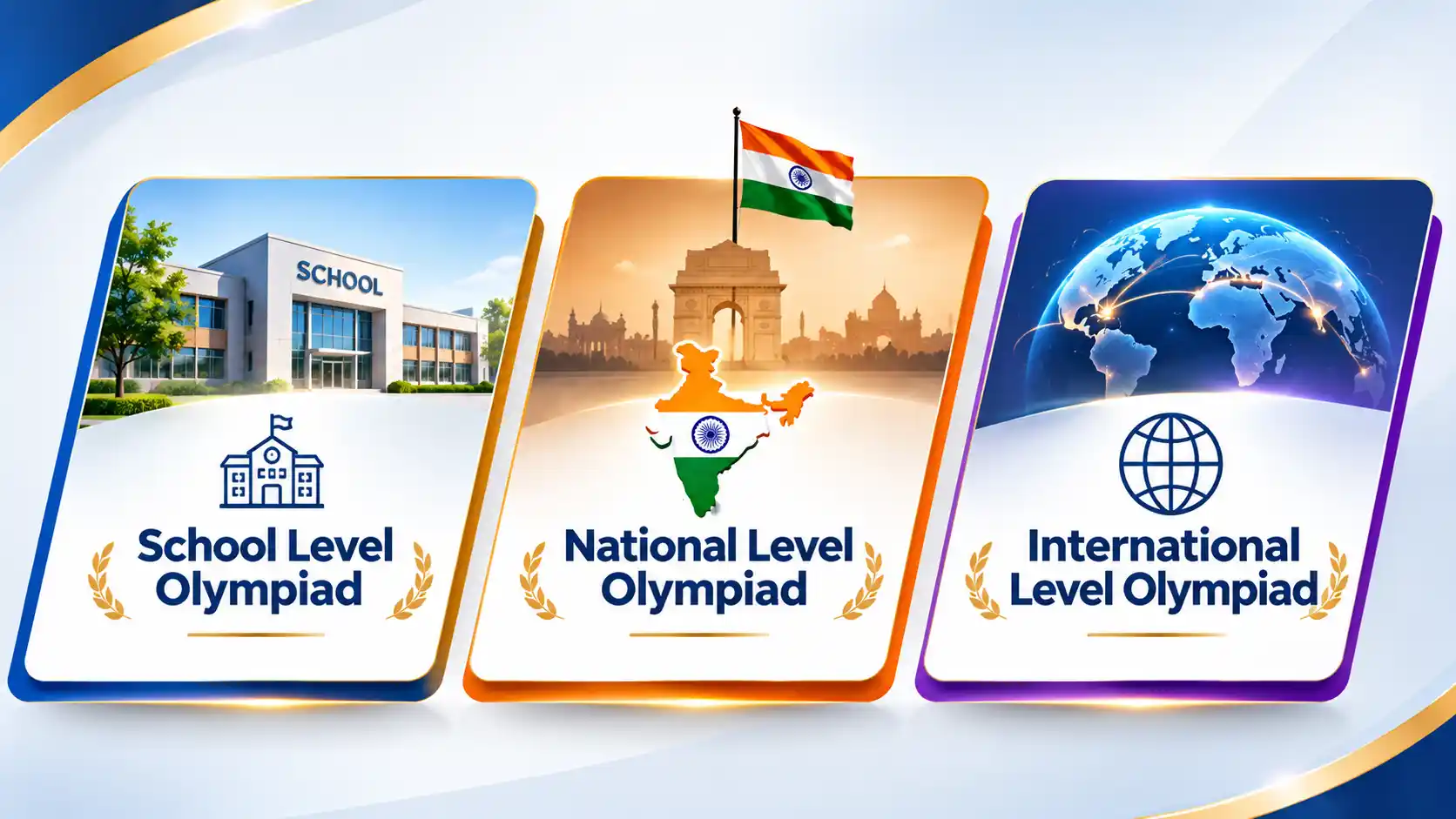
Quick answer: Competition levels show how wide a contest is. School-level Olympiads run within or between schools. National-level Olympiads bring together students from across a country. International-level Olympiads include participants from several countries. These levels are not separate subjects. Any subject can be offered at any level.
School-Level Olympiads
These are conducted through schools, often as a first step. They suit beginners because the format is familiar. Also, schools usually register students together.
National-Level Olympiads
These are open to students from schools across India. As a result, students compete against a much larger group. A well-known example is the Mathematical Olympiad programme run by the Homi Bhabha Centre for Science Education (HBCSE). It follows the stages IOQM, RMO and INMO.
International-Level Olympiads
These include participants from several countries. HBCSE’s programme leads to selection for the International Mathematical Olympiad. Meanwhile, some private organisers also use “International” in their exam names. Therefore, read the organiser’s rules to see who actually participates.
Benefits of Participating in Olympiad Exams
Quick answer: The different types of Olympiad exams are useful because they push students beyond rote learning. They encourage students to think, reason and solve unfamiliar problems. They also build confidence and time management. However, results depend on the child’s effort, preparation and the quality of guidance.
- Conceptual understanding: Questions test ideas, not memorised answers.
- Critical thinking: Students learn to compare options and justify answers.
- Problem-solving: Unfamiliar questions build flexible thinking.
- Calculation speed and accuracy: Timed papers reward quick, careful work.
- Confidence: Facing a larger contest builds self-belief.
- Healthy competition: Students learn to handle both wins and setbacks.
- Time management: Students practise pacing themselves.
- Academic development: Stronger fundamentals support regular school learning.
How to Choose the Right Olympiad for Your Child
Quick answer: Start with your child’s interests and current level. A beginner usually does well with a school-level or foundation-focused Olympiad. Then check the organiser’s eligibility, syllabus and dates. Finally, pick one or two types of Olympiad first so that preparation stays manageable.
- Observe which subjects your child enjoys.
- Ask the class teacher about your child’s strengths.
- Read the official syllabus and sample papers.
- Confirm the grade eligibility and exam dates with the organiser.
- Start with one Olympiad, then add more if your child is comfortable.
Students can usually take more than one Olympiad, as long as the exam dates do not clash and the workload is realistic. Rules differ by organiser, so check each one.
Why Should Schools Encourage Olympiad Participation?
Quick answer: Olympiads give schools a structured way to promote academic curiosity. In addition, they offer students a platform beyond the classroom. They also help teachers see where students need support. Principals and trustees often value the exposure that national-level contests provide.
- They encourage a culture of learning and healthy competition.
- They give teachers insight into students’ reasoning skills.
- They offer an external benchmark for student performance.
- They enhance a school’s visibility when students take part in national contests.
Schools can offer several types of Olympiad by contacting the organiser, nominating a coordinator and informing parents early. Many organisers register students through schools, so check the process on the official website.
MindPro Abacus & Vedic Math Olympiad 2026 – A National Platform for Students
Quick answer: MindPro Abacus & Vedic Math Olympiad 2026 is a national-level competition organised by EduPro Learning. It is open to students of Grades 1 to 10 from schools across India. It focuses on Abacus Mathematics and Vedic Mathematics. Round 1 is in December 2026 and Round 2 is in February 2027.
EduPro Learning is an experiential learning organisation. It offers Abacus, Mental Arithmetic, Vedic Mathematics and brain development programmes for schools and students. MindPro is the national platform where students can show what they have learned.
What MindPro Focuses On
- Mental maths and calculation speed
- Accuracy
- Logical thinking
- Focus and confidence
Recognition
Participants can receive trophies, medals, certificates and national recognition, subject to the official competition rules.
Moreover, MindPro lets students compete with peers from schools across India. As a result, they gain experience of a national stage. Visit MindPro Website to register your school or child and to read the official rules.
Frequently Asked Questions About Types of Olympiad
What are the different types of Olympiad exams?
Olympiad exams are grouped by subject and by level. Common subjects are Mathematics, Science, English, General Knowledge, Logical Reasoning, Computer Science, Social Studies, Abacus and Vedic Mathematics. The levels are school, national and international.
Which Olympiad is best for school students?
No single Olympiad is best for everyone. The right choice depends on your child’s interests, strengths and age. Beginners often start with a subject they enjoy. Also, a school-level exam is a good first step before a national contest.
At what age can children participate in Olympiads?
Age and grade rules differ by organiser. Some Olympiads accept primary-school students, while others start later. Therefore, always check the official eligibility notice. MindPro Abacus & Vedic Math Olympiad 2026 is open to Grades 1 to 10.
What is the difference between national and international Olympiads?
A national Olympiad brings together students from within one country. An international Olympiad includes participants from several countries. Also, some organisers use “International” in their names, so check who actually takes part.
What are the benefits of Abacus and Vedic Maths Olympiads?
These Olympiads build calculation speed, accuracy, concentration and confidence. They reward mental arithmetic skills. Besides, students also learn to stay calm under time pressure.
Can students participate in more than one Olympiad?
Yes, in most cases. Students can take several Olympiads, but only if the dates do not clash and the workload is manageable. Rules vary by organiser, so confirm before registering.
Conclusion
The different types of Olympiad exams give students many ways to learn, compete and grow. Subject-based Olympiads match a child’s interests, while competition levels decide the size of the stage. Parents and schools should compare syllabus, eligibility and dates before choosing. For students who enjoy mental maths, MindPro Abacus & Vedic Math Olympiad 2026 is a relevant national opportunity. EduPro Learning is proud to offer it as an experiential learning programme provider. Explore EduPro Learning to know more.
