

What is Vedic Math? A Simple Guide for Parents and School Leaders
What is Vedic Math, and why are so many schools talking about it? Vedic math is a set of mental math tricks that make calculations faster and easier. Children learn to solve sums in their heads instead of counting on fingers. However, parents and principals often ask if it really works. In this guide, you will learn where it comes from and how the main techniques work. You will also see what benefits to expect.
What is Vedic Math? The Basics Explained
Vedic math is a system of mental math methods. It uses simple patterns to solve problems in fewer steps. For example, a child can square 35 in a few seconds with one clever rule. As a result, students spend less time on routine sums and more time on thinking.
In other words, Vedic math teaches shortcuts that make sense. Students do not just memorize them. They also learn why each trick works, which builds real number sense. Moreover, many methods work from left to right, just like we read. That feels natural to young learners.
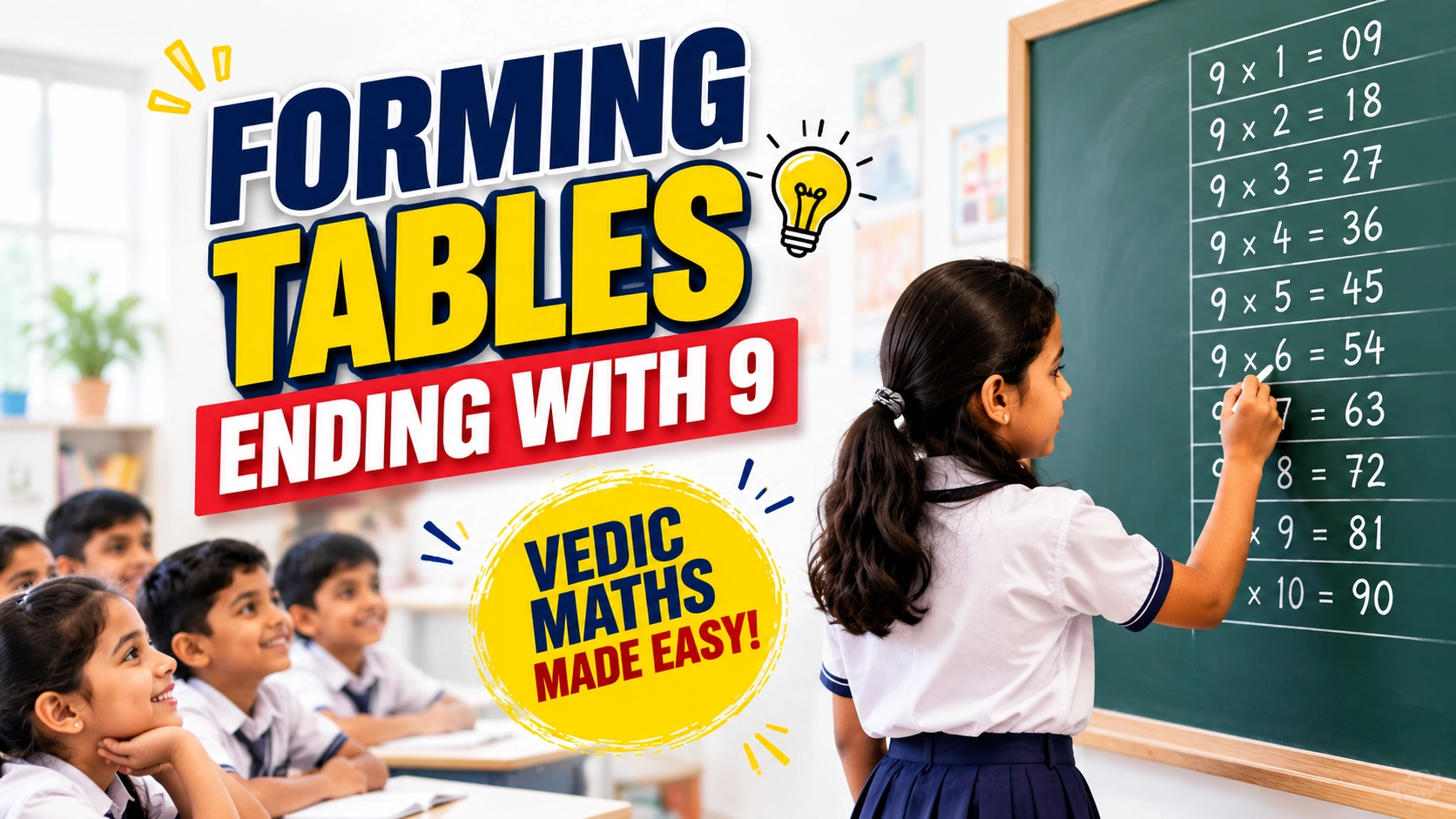
So, what is Vedic Math in a real classroom? It is a toolkit that sits beside the regular syllabus. Teachers use it to support addition, subtraction, multiplication, division, and squares. It does not replace standard methods. Instead, it gives children another way to check their work.
Where Vedic Mathematics Comes From
Vedic Mathematics became popular through Bharati Krishna Tirthaji, an Indian scholar and spiritual leader. His book on the subject appeared in 1965. It describes 16 short rules, called sutras, and 13 sub-sutras. Each sutra is a brief phrase that points to a calculation method.
However, scholars debate the link between these methods and the ancient Vedas. Historians say the sutras do not appear in the Vedic texts themselves. Even so, the techniques are real, and many of them work well. You can read more about this debate in the Wikipedia article on Vedic Mathematics.
Because of this, we recommend teaching it as a practical skill. It works best as a mental math toolkit rather than a history lesson.
Vedic Math Techniques With Simple Examples
Here are three popular techniques. Each one is easy to try at home.
Squaring Numbers That End in 5
Take the number 35. Multiply the first digit, 3, by the next number up, 4. You get 12. Then write 25 after it. The answer is 1225. This rule comes from a sutra that means “by one more than the previous one.”
Subtracting From 1000
Try 1000 − 467. Subtract each digit from 9, except the last digit. Subtract the last digit from 10. So 9 − 4 = 5, 9 − 6 = 3, and 10 − 7 = 3. The answer is 533. This method is often called “all from 9 and the last from 10.”
Multiplying Numbers Close to 100
Let’s multiply 98 by 97. Both numbers sit just below 100. The first is 2 short, and the second is 3 short. First, subtract crosswise: 98 − 3 = 95. Next, multiply the shortfalls: 2 × 3 = 06. Finally, join the two parts. The answer is 9506.
What is Vedic Math Good For? Key Benefits
Parents often ask what is Vedic Math good for beyond exam speed. Here are the main benefits teachers talk about:
- Faster calculation: students solve common sums in fewer steps.
- Better number sense: children see how numbers relate to each other.
- Higher confidence: quick wins make maths feel less scary.
- Sharper focus: mental work trains attention and memory.
- Easy answer checking: a second method helps students catch mistakes.
Large studies on Vedic math are limited, so schools should treat it as a helpful supplement. It supports the syllabus. It does not replace it. Still, many students enjoy the “aha” moments that these tricks create.

How Schools Can Add Vedic Math
Principals do not need a full curriculum overhaul. Start small instead. Choose one grade band and run a pilot for a term. For example, you could begin with grades 8 to 10, where speed and accuracy matter most for exams.
Many schools prefer to work with a trusted partner. EduPro Learning is a leading provider of experiential learning programs in India. Our Vedic Math Program For School is built for grades 6 to 10. It gives teachers a clear plan and gives students hands-on practice.
Vedic Math Olympiad
A Vedic Math Olympiad is a mathematics competition designed to help students develop faster calculation skills, numerical accuracy, logical thinking, concentration, and problem-solving abilities through Vedic Mathematics techniques. It encourages students to explore innovative calculation methods, improve their confidence in mathematics, and apply their knowledge to solve problems quickly and efficiently. The Olympiad provides a platform for students to test their mathematical skills, challenge themselves, compete with peers, and develop a positive attitude towards learning mathematics.
FAQ’S
What is Vedic Math in simple words?
It is a set of easy mental math tricks. They help children calculate faster and with more confidence.
Which grades can learn Vedic math?
Children can start once they know basic number operations. However, the benefits grow in the middle and senior years. For that reason, our program focuses on grades 6 to 10.
Does Vedic math replace regular maths?
No, it does not. Students still learn standard methods in class. Vedic techniques simply add speed, variety, and a way to double-check answers.
Is Vedic math hard to learn?
Not at all. Most techniques take only a few minutes to learn. Nevertheless, students need regular practice to build speed.
Conclusion: What is Vedic Math Worth to Your School?
By now, the answer to what is Vedic Math should be clear. It is a smart toolkit for mental calculation. Parents get children who solve sums with confidence. Principals get a fresh, practical skill that supports the syllabus. Moreover, the techniques are simple enough to start this term.
Ready to take the next step? Explore our EduPro Learning’s VedicPro Vedic Math Program and see how it fits your timetable.
Bring Vedic Maths to Your School! Enquire Now
